

OPENING HOURS
Mornings: 10 AM – 2 PM (Tuesday to Sunday)
Afternoons: 5 PM – 7 PM (Thursday, Friday, and Saturday)
Closed: Monday (weekly rest day)
CONTACT
C/ Beato Fray Domingo de Henares 5, (Casa de la Tercia Building)
Tel. 957 671 946 | 647 572 641
The museum is housed in the historic Casa de la Tercia, located in the heart of the city’s old town. This building, constructed between 1792 and 1795, was originally used as a grain and seed store, as well as an olive oil warehouse. It was initially intended to centralise church tithes and other royal revenues.
After the Mendizábal Expropriation of 1841, the Casa de la Tercia changed hands and lost its original purpose. In the 20th century, it was transformed into an inn and later became a prison during the Spanish Civil War (1936-1939).
The Casa de la Tercia stands out as one of the most prominent buildings in Baena. With its large size and impressive presence, it serves as an architectural symbol of the province.
Since 1960, the Town Hall rented the building until 1984, when it acquired it as part of its municipal heritage and carried out significant renovations. It is located at Calle Santo Domingo de Henares 5, near the Town Hall.
The museum opened its doors in 1999 on the first floor and was officially registered as the Museo Histórico de Baena (Historical Museum of Baena, Córdoba) in the Andalusian Museums Registry by an order dated February 7, 2000 (BOJA No. 35, March 23, 2000).
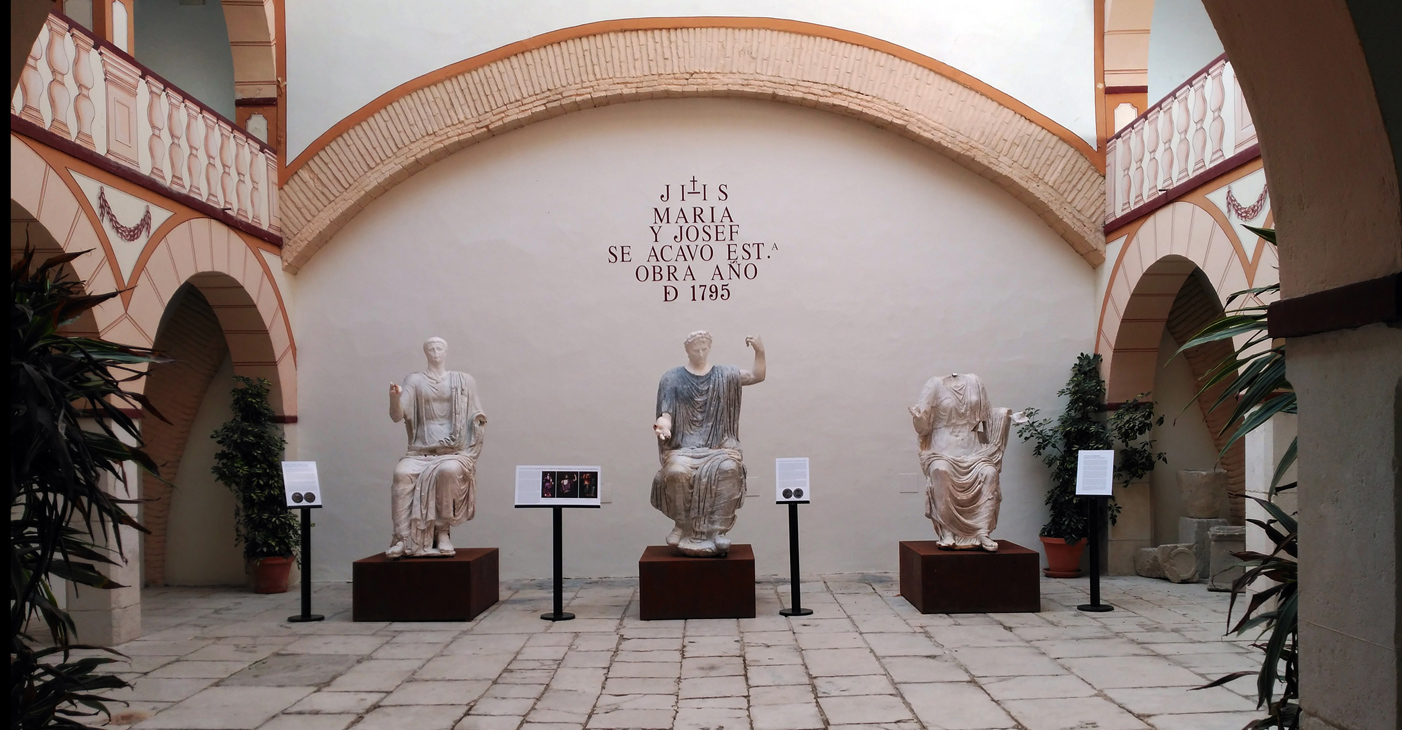
In 2010, the building was renovated as the museum’s headquarters and reopened in February 2011. It stands out for its remarkable archaeological collections, mainly from excavations in the Torreparedones Archaeological Park, including the votive collection from the sanctuary and Roman sculptures from the Roman forum.
The main facade has symmetrical openings protected by wrought iron bars and is decorated with a visual illusion that mimics rusticated stone blocks above a high stone plinth.
In the center, a baroque doorway with a broken pediment provides access to the reception area, the first room, and the stairs leading to the upper floors.
At the back, a large porticoed courtyard stands out, the most characteristic feature of the architectural complex, decorated with trompe l’oeil that simulates garlands, balustrades, and other architectural elements.
The exhibition is organized chronologically, beginning with Prehistory in Room I and concluding in Room XII, which contains a gallery of portraits of notable figures from Baena, as well as documents, books, and other items from the modern and contemporary periods. The museum features three unique collections: the Iberian-Roman votive offering from the southern sanctuary of Torreparedones, with numerous stone ex-votos representing anthropomorphic figures (both female and male) as well as anatomical ex-votos (legs); the Iberian-Roman numismatic collection, which includes coins from various mints (Acinipo, Bora, Colonia Patricia, Iulia Traducta, Obulco, Carmo, Castulo, Emerita Augusta, Ulia, etc.), coins from many Republican families (Calpurnia, Pompeia, Flaminia, Julia, Papiria, Satriena, etc.), and coins from nearly all the emperors of the early and late Empire (Julius Caesar, Augustus, Tiberius, Claudius, Nero, Hadrian, Gordian, Constantine, Faustina, Theodosius, etc.); and lastly, the large-format Roman statues collection (several togas from Iponoba and Torreparedones, with monumental seated sculptures of Augustus, Caligula/Claudius, and Livia).
The majority of the collection is displayed in Room IV, dedicated to Roman daily life and funerary practices, featuring ceramic and metal kitchenware, glass, lead, and small bronze objects, among which are notable phallic amulets, fittings for situlas, and other decorative materials. In the funerary section, there are replicas of urns from the so-called “Mausoleum of the Pompeys” in Torreparedones and gravestones from various origins. From the Visigothic period, two pieces with inscriptions and Christian motifs stand out, reflecting the origin and deep-rooted presence of Christianity in the Guadajoz River area: a gold ring and a bronze bowl, both decorated with the chrismon symbol and the names of their owners, Sabina and Nico, respectively. In Room XII, a facsimile of the Cancionero de Baena is displayed, the original of which is kept in the National Library of Paris.